

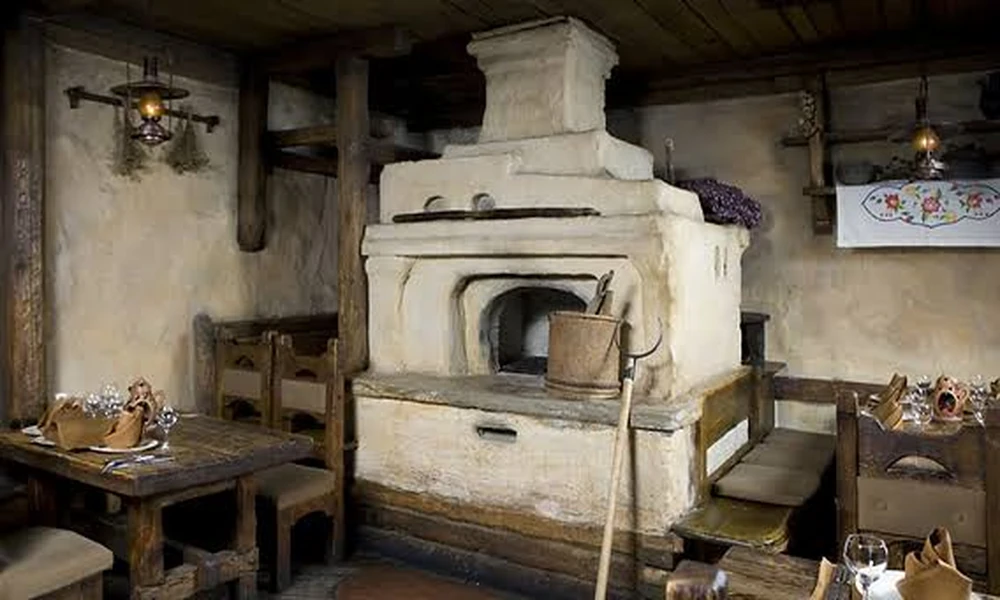
Three hundred years ago, staying warm in a New England winter meant sitting as close to an open fire as possible without catching your coat on the flames. Today, a wall-mounted heat pump keeps a Bangor farmhouse at 68 degrees using electricity and outdoor air, while the family barely notices the system running. The distance between those two realities is one of the most fascinating engineering stories in American domestic life, and it played out more dramatically in this corner of the country than anywhere else.
This is that story, told in four distinct eras, with a look at where Maine sits right now and what the next shift is already doing to the region.
The Wood Era: A Fireplace That Mostly Failed You
For the first two centuries of European settlement in New England, wood was the only game in town. That sounds cozy in retrospect, but the reality was miserable. When English settlers arrived in Massachusetts in the early seventeenth century, they recreated the open fireplaces and broad chimneys of their home country, which was a wildly inefficient system in a place as cold as New England. Large fires created powerful drafts, drawing cold air into the houses through gaps and cracks, so much heat was sucked up the chimney that one New Englander wrote in 1828 that “one would think that the warmth generated by the combustion of wood, or other fuel was considered as a nuisance.”
The fix arrived in 1741 when Benjamin Franklin introduced his cast-iron stove, a device specifically designed to push heat into a room rather than let it escape up the flue. Fireplaces remained the primary form of home heating until Franklin invented a safer, more efficient stove, a variation of which still bears his name today. It was a genuine leap forward. Still, wood remained dominant through most of the 1800s, meaning countless cords stacked against barn walls every fall, and children hauling logs before school on dark January mornings.
Coal and Oil Rewrite the Rules
Around 1885, coal surpassed wood as the nation’s primary fuel. In New England, that shift meant urban row houses could finally heat multiple rooms reliably, and the basement furnace became a status symbol rather than a curiosity. Cast iron radiators hissed their way through the Victorian era, and for the first time, middle-class families could sleep in warm bedrooms.
Oil followed coal, and it followed fast. The household oil burner came into prominence in the 1920s, and by the 1930s heating oil was appearing in new construction and coal-boiler retrofits alike. After World War II, it became the dominant residential fuel in the Northeast. Oil delivery trucks became a fixture of winter life across the Mid-Atlantic and New England, bringing a constant supply, smaller tanks, and no more shoveling. For Mainers especially, this felt like the permanent answer.
The scale of that old reliance on solid fuels is striking in hindsight. According to the U.S. Energy Information Administration, in 1940, three out of every four American homes still relied on coal or wood for heat, per U.S. Census data. The oil era compressed decades of transition into roughly two post-war generations.
Maine’s Unusual Relationship With Heating Oil
Most of the country eventually switched to natural gas. Maine did not, and that single fact shaped everything about how the state thinks about heat today. Maine’s geology and low population density made natural gas pipelines economically impractical outside a handful of urban corridors, so heating oil stayed entrenched long after it retreated elsewhere.
That dependence came with real costs. Maine remains the most heating oil dependent state in the country, making it vulnerable to shifting global oil markets and burdening households with high energy costs. Oil and kerosene are some of the most volatile and expensive energy sources for home heating, with oil reaching nearly $6 per gallon and kerosene over $7 per gallon in 2022.
The slow erosion of that dependence is now well documented. According to the Maine Department of Energy Resources (January 2026), approximately 50 percent of all Maine households rely on fuel oil as their primary heat source, although that figure has declined steadily from 70 percent in 2010. Electricity use for home heating has increased significantly with heat pump adoption. That is a 20-point drop in roughly 15 years, and the pace is accelerating.
The Four-Era Framework: Reading Where Your Home Sits in History
One useful way to think about Maine heating history is what you might call the Four-Era Framework: Wood (pre-1880s), Solid Combustion (1880s to 1940), Oil Dependency (1940 to roughly 2010), and the Electrification Era we are in now. Most Maine homes alive today were built during the Oil Dependency era and were designed around it. Understanding which era your house was engineered for tells you a lot about what upgrade path makes sense next.
| Era | Primary Fuel | Approximate Period | Key Infrastructure |
|---|---|---|---|
| Wood | Firewood | Pre-1880s | Open fireplace, Franklin stove |
| Solid Combustion | Coal | 1880s to 1940 | Basement furnace, cast iron radiator |
| Oil Dependency | Heating oil | 1940 to ~2010 | Oil boiler, forced hot air, delivery truck |
| Electrification | Electricity (heat pump) | ~2010 to present | Air-source heat pump, mini-split |
The science behind heat pumps is older than most people realize. Lord Kelvin developed the theoretical concept in 1852 and is commonly held responsible for formally describing the thermodynamic principles that underpin heat pumps. The idea sat mostly dormant for a century while cheap oil flooded the market. Now that the economics have flipped, the technology is catching up fast.
Choosing a Heating System in Modern Maine: A Practical Checklist
History is context, but your January heating bill is immediate. If you are evaluating your options right now, these four questions cut through most of the noise:
- What era is your home’s infrastructure? An oil-era home with existing duct work may be a strong candidate for a heat pump upgrade. A pre-1940 home with cast iron radiators needs a different conversation about compatibility.
- Do you need backup fuel? Maine winters push below zero. Many households choose a hybrid setup: a heat pump for the bulk of the season and oil or propane as a backup when temperatures drop past the pump’s efficient range.
- What rebates are available? Maine’s Efficiency Maine program offers significant financial incentives for qualified installations. Factor those in before comparing sticker prices on equipment.
- Who is actually doing the work? Installation quality matters more than brand choice for heat pumps. A poorly sized or improperly charged system underperforms regardless of the nameplate. For a Bangor-area homeowner navigating all of this, working with a trusted Maine family-owned heating company that has been doing this since before heat pumps were mainstream means you get honest sizing advice rather than a one-size pitch.
“Maine remains the most heating oil dependent state in the country.” The Maine Department of Energy Resources has flagged this reality repeatedly as the core reason the state has pushed heat pump adoption harder and earlier than most other states, treating it not as an environmental nicety but as an economic necessity for household budgets.
What Comes After the Electrification Era
Every era in this history ended because something cheaper, cleaner, or more convenient replaced it. Wood gave way to coal because coal burned longer and didn’t require a forest behind the house. Coal gave way to oil because oil arrived in a truck and needed no shoveling. Oil is giving way to electricity because the grid is getting cleaner and heat pumps move heat instead of generating it, making them far more efficient per dollar spent.
What replaces electrification is genuinely unclear. Cold-climate heat pump technology keeps improving. Battery storage is creeping into homes. Geothermal is getting cheaper. But one thing the four-era arc makes obvious is that the transitions always come faster than the industry expects, and they always leave behind households that waited too long to adapt.
New England took three centuries to get from the open hearth to the inverter-driven mini-split. The next chapter will probably take three decades. Getting ahead of it is the smartest home decision most Mainers can make right now.